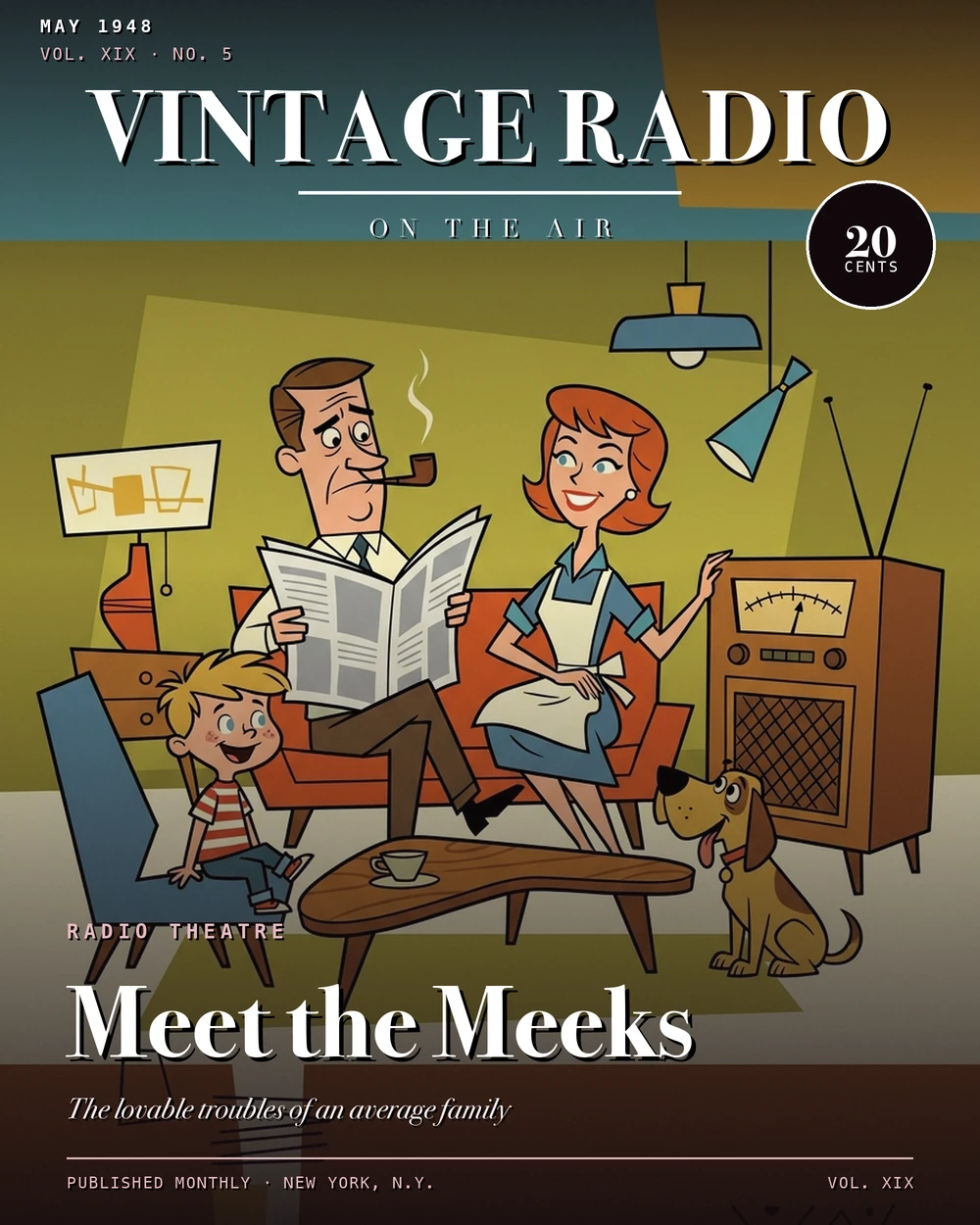
Meet the Meeks
The Show and Where It Came From
Meet the Meeks was a revival. The original program, Meet Mr. Meek, had run on NBC from 1940 to 1942, and when the concept came back in August 1947 it returned with a refreshed cast and the same core premise — a mild-mannered, frequently put-upon father navigating the cheerful chaos of domestic life. The show aired Saturday mornings at 11 a.m. on NBC, originating from WMAQ, the network's own station in Chicago. All-Sweet Margarine sponsored the run, a comfortable fit with the show's target audience of homebound weekend listeners. It ran through February 5, 1949, producing a catalog of around 70 episodes across roughly a year and a half.
The Chicago origin matters. By the late 1940s, NBC's Chicago operations were a hub for radio talent — actors, singers, and comedians who moved fluidly between soap operas, adventure serials, and sitcoms. Meet the Meeks drew directly from that pool, assembling a cast already deeply familiar with live radio production. The result was a show that sounded polished and comfortable, with performers who knew how to pace a 30-minute comedy and land a joke without overselling it.
Mortimer, Agatha, and the Rest of the Family
The heart of the show was Mortimer Meek, played by veteran actor Forrest Lewis. Mortimer fit a recognizable radio comedy type: the decent, well-meaning man who finds himself perpetually outmaneuvered by the people around him. He wasn't a fool, but he was the kind of father who got swept up in whatever scheme his wife or daughter had going that week. Lewis, born November 5, 1899, in Knightstown, Indiana, had spent years working Chicago-based radio before landing this role, and the experience showed. He gave Mortimer a warmth and a resignation that kept the character sympathetic rather than cartoonish.
Playing opposite Lewis was Fran Allison as Agatha Meek. Allison had been an NBC staff singer and radio personality before Meet the Meeks, appearing in soap operas and comedies across the Chicago broadcasting scene. Her Agatha was the kind of wife who launched the household into motion — frequently at the center of whatever situation each episode was built around. Allison was already a recognizable voice to Chicago radio audiences, and the chemistry between her and Lewis gave the show its domestic credibility. Within a year of Meet the Meeks ending, she would begin her long run as the human host of the television puppet show Kukla, Fran and Ollie, which aired from 1948 to 1956 — the role that made her a nationally known figure.
Beryl Vaughn played Peggy Meek, the daughter, and several episode titles point to her as a significant driver of storylines — "Is Peggy Eloping," "A Peggy Problem," and more. Cliff Soubier took on Uncle Louie, identified in the show as Mrs. Meek's brother and a recurring presence whose own romantic life apparently warranted at least one dedicated episode ("Should Uncle Louie Get Married"). Rounding out the household was Elmira Roessler as Lilly, the Meeks' once-a-week maid. Vaughn and Soubier were also cast members of the NBC Chicago adventure serial Sky King during the same period, a small detail that underscores just how interconnected the Chicago radio talent pool was at the time.
What the Episodes Were Built On
The episode titles in the catalog give a good picture of how the show worked week to week. Stories like "The Charity Bazaar," "The French Teacher," "Rekindling Romance," and "Rhumba Lesson and Secret Portrait" point to a comedy of small social ambitions and domestic missteps. Someone wants to take a language class, someone gets quoted in a newspaper article without wanting to be, someone's suitcase ends up in the wrong locker. These aren't high-stakes plots — they're the texture of ordinary life, slightly exaggerated for comic effect.
The format followed a familiar sitcom pattern: a misunderstanding or small domestic project sets things in motion, complications pile up through the episode, and by the end some combination of humor and sentiment restores the household's equilibrium. "Socrates Sylvester Fermish" stands out as a title that suggests something more eccentric was occasionally in the mix. "Newspaper Article Mix-Up" and "The Turn About Party" suggest the show also enjoyed flipping social expectations and watching the family scramble. Each episode ran approximately 30 minutes — long enough to develop a situation properly, short enough that the pace had to stay sharp.
The Saturday morning slot shaped the show's sensibility. This wasn't late-night drama or prime-time spectacle; it was programming aimed at families already awake and going about their weekend. The comedy needed to be accessible, warm, and quick to establish its situation. All-Sweet Margarine as sponsor reinforced that domestic, household-friendly positioning.
The Cast After the Show
One of the more interesting aspects of Meet the Meeks is how many of its cast members went on to recognizable later careers. Forrest Lewis, who gave Mortimer his particular brand of put-upon decency, transitioned into film and television work through the 1950s and 1960s — The Andy Griffith Show, Gomer Pyle U.S.M.C., The Absent-Minded Professor, Son of Flubber — a range of projects that show how well his everyman quality translated from radio to the screen. He worked steadily until his death in June 1977.
Fran Allison's trajectory was even more public. Kukla, Fran and Ollie began in 1948, while Meet the Meeks was still on the air, and it became one of the most warmly received programs of early television. She died in June 1989. The show she and Lewis made together on Saturday mornings in Chicago belongs to the earlier chapter of both their careers, but it's a chapter worth knowing — a working radio comedy that gave two substantial performers steady material during a period when radio was still the dominant form of broadcast entertainment.
The roughly 70 episodes in the catalog make Meet the Meeks one of the more complete records of what a late-1940s NBC family comedy actually sounded like from week to week: the rhythms of the scripts, the way the cast handled recurring characters, the specific texture of a sponsored Saturday morning program aimed at American households in the years just after the war.